Hisashi Ouchi Photos: The Real Story Behind the Era’s Most Haunting Nuclear Tragedy
Hisashi Ouchi Photos: The Real Story Behind the Era’s Most Haunting Nuclear Tragedy
In a moment that seared itself into the annals of nuclear history, Hisashi Ouchi’s battered faces—etched permanently in photographic memory—stand as silent testimonies to the unbridled risks of human error and technological failure. Hisashi Ouchi, a nuclear reactor operator whose fateful exposure to intense radiation defined a catastrophic incident at the Monju prototype fast-breeder reactor in Japan on September 30, 1999, became a symbol of both human endurance and fragility in the face of catastrophic nuclear exposure. The haunting images captured in the days following his ordeal offer not just clinical documentation but a deeply personal portrait of suffering, resilience, and the moral reckoning that followed one of the worst accidents in civilian nuclear energy history.
The incident unfolded during a routine maintenance test of the Monju reactor, operated by Japan’s Institute of Nuclear Energy Research.Ouchi, a trained technician with over a decade of experience, entered the reactor chamber on September 30 to replace a faulty element. Without adequate protective equipment or proper radiation shielding—gaps in safety protocols—Ouchi was exposed to extreme levels of ionizing radiation, estimated at over 17 sieverts, a dose lethal within days for unprotected human tissue. Within hours, symptoms emerged: nausea, vomiting, internal bleeding, organ failure, and a disintegration of blood cells.
What followed was a grueling, public battle for survival, intensity amplified by the dramatic photographs captured in the aftermath—images that revealed not just his physical condition but the moral weight of the situation.
Photographs taken during Ouchi’s hospitalization and subsequent recovery reveal a harrowing human toll. These images—crystal-clear in their depiction—show Ouchi’s skin peeling, eyes clouded, veins distorted, his body weakened to near collapse.
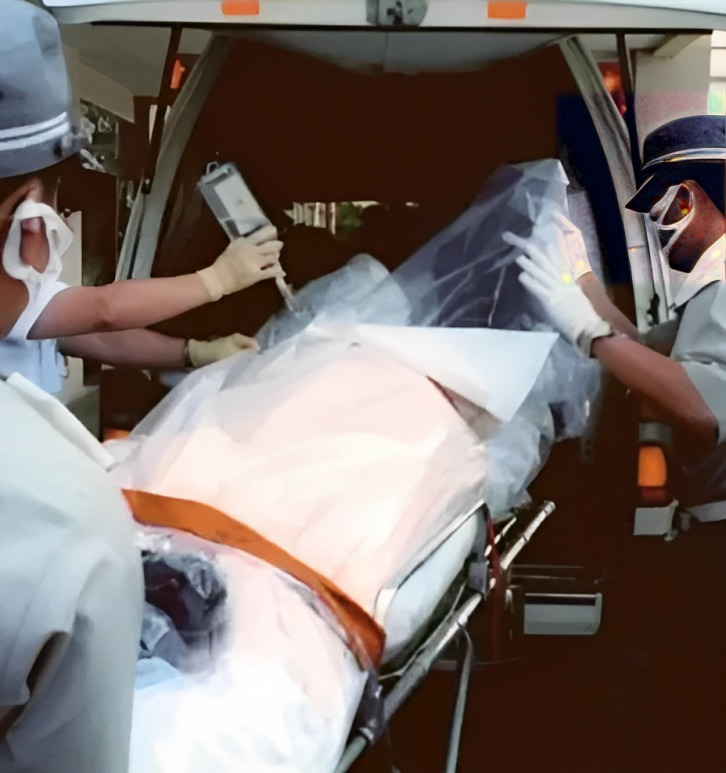
One particularly moving photo captures him lying in hospital bed, pale and fragile, draped in Medical Brand uniforms, a stark contrast to the high-pressure professional environment he once occupied. Another shows medical staff in full radiation suits, faces masked, conveying both technical precision and deep empathy. “These weren’t just clinical records,” noted Dr.
Akira Tanaka, a radiology expert consulted for the case. “They’re visceral proof of damage no chart can fully convey—tissue breakdown, cellular collapse, the body’s betrayal under radiation.” The photos document more than medical deterioration; they embody a human tragedy steeped in systemic failures.
What made the Monju accident and Ouchi’s exposure so significant beyond immediate medical response was the systemic context: inadequate training, lax safety culture, and oversight gaps within Japan’s nuclear regulatory framework.
Despite advances in reactor design, the incident exposed vulnerabilities that had long been flagged internally and by international observers. Ouchi’s case became a catalyst for reevaluating reactor operation protocols, radiation safety standards, and emergency preparedness. In official after-action reports, the International Atomic Energy Agency noted that “Ouchi’s exposure underscores the necessity of rigorous procedural compliance and real-time monitoring in high-risk nuclear environments.” Beyond policy, the images solidified Ouchi’s place in public consciousness—not as a statistic, but as a human story of endurance against overwhelming odds.
Ouchi remained in a coma for 83 days, a unimaginable temporal stretch marked by compression of time and slow, silent strength. Though he never regained cognitive function, his survival defied grim expectations, inspiring both reverence and soul-searching. The photos, preserved by both official archives and independent researchers, serve as urgent reminders of radiation risks—tools for education, prevention, and remembrance.
They capture not only physical degradation but psychological endurance: the struggle to retain identity amid disintegration, hope amid despair. As one nuclear safety scholar observed, “These images are irreplaceable. They don’t sensationalize; they confront.
They demand accountability, vigilance, and humility in how society manages powerful technologies.”
Hisashi Ouchi’s story, frozen forever in chiaroscuro photographs, continues to resonate—a complex interplay of science, ethics, and human vulnerability. His legacy is not one of triumph, but of sober reflection. In the quiet dignity preserved by each frame, there lies a powerful call: to Never forget the cost of power, and to honor those whose lives reveal both the fragility and resilience of the human spirit in the age of nuclear science.


Related Post

Lions vs Packers: A Showdown Designed to Ignite — Stat Survival Guide to Score Science
Paul Reubens: Peewee Herman’s Velocity Icon Dies at 70, Ends a Pub Crawl With Legacy That Endures</h2> In a twilight marked by both cinematic memory and untold facets of his life, Paul Reubens, the man behind the slobbery, eccentric, and outspoken Peewee Herman, passed away at 70. Known for redefining childhood rebellion on screen, Reubens’ death closes a chapter in American pop culture, one that blended vulgar humor with heartfelt authenticity. Once a household name from the 1980 hit film, his legacy extends far beyond the red-and-white striped shorts, now inseparable from the character who captured a generation’s cantankerous charm. <p>Born in Baltimore, Maryland, in 1952, Reubens emerged not just as an actor but as a performer unafraid of pushing boundaries. His embodiment of Peewee Herman—a defiant, snarly-haired antihero—blended physical comedy with sharp, streetwise dialogue that struck a chord with audiences hungry for authenticity. The Peewee Herman series, though commercially successful, often overshadowed Reubens’ broader artistic range. Few realize he appeared in Broadway plays, voice acting, and even avant-garde theater, proving his talents extended well beyond children’s television. As *Chicago Sun-Times* noted in its obituary, “Reubens was more than a child star—he was a performer who leveraged innocence into subversion.” <h3>A Career Built on Risk and Voice</h3> Reubens’ early career was defined by bold choices. Before Peewee, he starred in off-Broadway productions such as *The Spook Who Sat by the Door*, where his dramatic range simmered beneath the surface, hinting at complexity beneath the goof. With Peewee Herman, launched in 1985, he abandoned subtlety entirely: “Make them laugh, make them weird, make them remember,” Reubens once said, capturing the essence of his performative philosophy. The character’s signature voice—raspy, gravelly, dripping with sass—became iconic, a vocal signature recognized by millions. <p>The 1980s explosion of Peewee Herman’s films turned Reubens into a curious cultural paradox: a serious actor whose most beloved role was pure absurdity. Yet, in interviews, he insisted his performance was deliberate—a nuanced portrait of teenage defiance. “I didn’t play a cartoon character,” he explained. “I played a version of me—rough around the edges, protective of friends, screwed up, but loyal.” This authenticity resonated in an era increasingly skeptical of artificial corporate branding, making Peewee’s appeal timeless. <h2>Personal Life and Shadows Beyond the Spotlight</h2> Beyond the screen, Reubens navigated a life marked by both acclaim and private complexity. Always a confessed fan of rock ’n’ roll and jazz, his persona extended into music and visual art, though these pursuits rarely entered mainstream discourse. He resided in New York’s Greenwich Village, a neighborhood steeped in artistic tradition, maintaining long-standing friendships with peers across disciplines. <p>Despite the glare of fame, Reubens valued privacy fiercely. The Velvet Crimeoclub — a performance space and cultural hub — served as a sanctuary where he entertained trusted artists and writers. In rare public appearances, he spoke candidly of battling creative stagnation and the weight of typecasting, once remarking, “People remember the mask, not the man.” Such reflections humanized the performer, revealing layers beneath the red-and-white attire. <h3>Leadership, Mentorship, and the Legacy of Peewee</h3> Reubens’ influence reached beyond performance into mentorship. He supported emerging artists through workshops and collaborative projects, particularly those exploring boundary-pushing storytelling. The Peewee Herman Archive, now studied in theater programs, illustrates how he transformed personal quirks into universal themes of identity and belonging. <p>The character became a cultural touchstone, symbolizing youthful rebellion and resilience, but Reubens resisted reducing himself to a symbol. “Herman isn’t me,” he clarified in *Sun-Times* features, “he’s a story I inherited—and a story I continue telling, oddly enough, decades later.” This duality—public icon, private craftsman—defined his enduring presence. <h2>Enduring Impact: Why Peewee Herman Still Slaps the Nerve</h2> Even after the curtain fell, Peewee Herman retains pulse in internet memes, fashion revivals, and genre homages. His snarl, “You ya ridiculous—bury me!” echoes in viral clips and social commentary. Yet Reubens’ true legacy lies not in viral fame but in the authenticity he brought to every role. <p>Critics and fans alike praised his ability to fuse humor with emotional truth. As theater historian Dr. Elena Park observed, “Reubens taught audiences that vulnerability and absurdity coexist. He made slobberness feel sincere.” Whether in a Intervals show, a Broadway curtain call, or a private art session, Paul Reubens remained fundamentally creative—too often typecast, never fully understood. <h1>Paul Reubens, Peewee Herman’s Velocity Icon Dies at 70 — Ends a Velocity Legacy That Never Grew Old

Firdaus Oiwobo: Legal Fury and the Controversy Around Lawyers who Challenged Power


